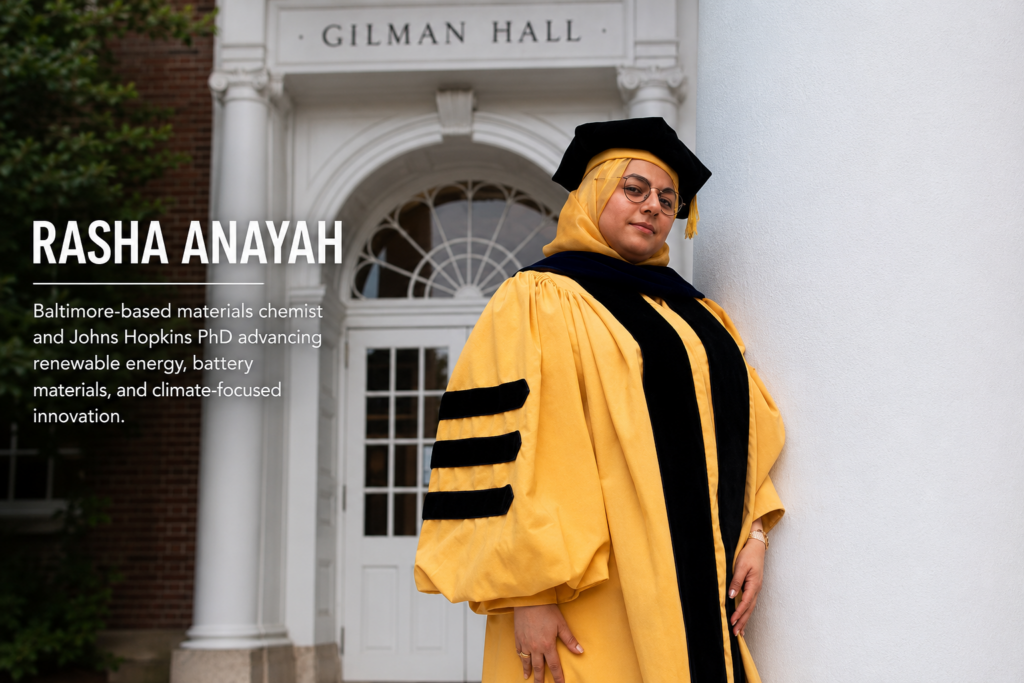
Rasha Anayah is a Baltimore-based materials chemist and Johns Hopkins PhD advancing renewable energy, battery materials, and climate-focused innovation.
At the intersection of chemistry, clean energy, and practical problem-solving, Dr. Rasha Anayah represents a new generation of scientists focused on translating advanced research into meaningful solutions for the future. Her work brings together materials chemistry, electrochemistry, renewable energy, and next-generation battery technologies, with a particular focus on the development of metal-organic frameworks and other advanced materials that may help address the growing global demand for cleaner and more efficient energy storage.
Based in Baltimore, Maryland, and trained at Johns Hopkins University, Dr. Rasha Anayah has built her research career around a clear scientific purpose: using the tools of chemistry to solve practical problems. That mission has guided her academic and professional path, especially during the past eight years, as her work has increasingly focused on developing solutions connected to climate change, sustainable energy, and the future of battery technology.
A Scientific Foundation Built at Johns Hopkins University
Dr. Rasha Anayah earned her PhD in Chemistry from Johns Hopkins University, one of the most respected research institutions in the United States. Her doctoral training provided a strong foundation in chemical research, scientific analysis, experimental design, and interdisciplinary problem-solving.
Johns Hopkins University has long been associated with rigorous research, scientific discovery, and innovation across fields ranging from medicine and public health to engineering, chemistry, materials science, and energy-related research. For Dr. Anayah, earning a chemistry doctorate from Johns Hopkins placed her within a research environment known for intellectual depth and practical impact.
Her education gave her the ability to approach complex scientific problems from multiple angles. In materials chemistry and electrochemistry, that kind of training is especially important. The design of new materials for energy storage requires not only a deep understanding of molecular and structural behavior, but also an ability to think about performance, durability, scalability, and real-world application.
As a Johns Hopkins-trained chemist, Dr. Rasha Anayah brings together technical expertise and an applied research mindset. Her work reflects a commitment to chemistry as both a fundamental science and a tool for solving urgent global challenges.
Chemistry as a Tool for Practical Problem-Solving
Throughout her research career, Dr. Rasha Anayah has focused on using chemistry to address practical problems. This applied perspective is central to her professional identity.
Chemistry is often described as the central science because it connects physics, biology, materials science, engineering, medicine, and environmental research. For scientists working in climate and energy, chemistry is particularly important because many of the world’s most pressing sustainability challenges depend on the discovery, design, and optimization of new materials.
Energy storage is one of those challenges. As society moves toward renewable energy sources such as solar and wind, the need for reliable, efficient, and scalable battery technologies continues to grow. Renewable power generation is essential, but energy must also be stored effectively so it can be used when and where it is needed. That makes battery research a critical part of the clean energy transition.
Dr. Anayah’s work fits directly into this larger scientific landscape. By focusing on materials chemistry, electrochemistry, metal-organic frameworks, and next-generation batteries, she contributes to research areas that may help improve how energy is stored, transferred, and used.
Her work is not simply about advancing chemistry in theory. It is about applying chemical knowledge to problems that matter beyond the laboratory.
Working at the Interface of Materials Chemistry and Electrochemistry
Dr. Rasha Anayah’s current research sits at the interface of materials chemistry, electrochemistry, and renewable energy. This combination is especially important for the development of next-generation battery systems.
Materials chemistry focuses on the design, synthesis, structure, and performance of materials. Electrochemistry focuses on the relationship between chemical processes and electrical energy. When these fields come together, they become essential to battery research, energy conversion, energy storage, catalysis, and many other technologies connected to the clean energy economy.
Next-generation batteries require materials that can perform under demanding conditions. Scientists must consider conductivity, stability, energy density, charge and discharge behavior, safety, cost, and environmental impact. The materials used in these systems can determine whether a battery is efficient, durable, scalable, and practical for broader use.
This is where Dr. Anayah’s research focus becomes highly relevant. By working with advanced materials, including metal-organic frameworks, she is contributing to a field that seeks better ways to store and manage energy. Her work reflects a broader scientific effort to develop battery technologies that can support renewable energy systems, electric transportation, grid storage, and other climate-related needs.
Metal-Organic Frameworks and the Future of Energy Materials
One of the important areas in Dr. Rasha Anayah’s work is the design of metal-organic frameworks, often known as MOFs. These materials have attracted significant interest across chemistry and materials science because of their highly tunable structures.
Metal-organic frameworks are built from metal ions or clusters connected by organic linkers. This architecture can create porous structures with large internal surface areas and customizable chemical properties. Because of that flexibility, MOFs are being studied for a wide range of potential applications, including gas storage, separation, catalysis, sensing, carbon capture, and energy storage.
In the context of battery research, materials like MOFs are especially interesting because scientists can modify their structures and properties to influence how ions move, how charge is stored, and how materials behave under electrochemical conditions. The ability to design materials at the molecular and structural level gives researchers a powerful way to explore new possibilities in energy technology.
Dr. Anayah’s focus on metal-organic frameworks connects her work to one of the most dynamic areas in modern materials chemistry. It also reflects the broader direction of renewable energy research, where innovation often depends on creating materials that are more efficient, adaptable, and suited to specific energy applications.
Renewable Energy and the Battery Challenge
Renewable energy is central to the future of climate solutions. Solar, wind, hydro, and other renewable sources offer cleaner alternatives to fossil fuels, but the transition to renewable energy also requires better systems for storing electricity.
Batteries play a major role in that transition. They are needed for electric vehicles, portable electronics, grid-scale storage, backup systems, and renewable energy integration. As demand grows, researchers are working to develop batteries that are safer, longer-lasting, more energy-dense, more affordable, and less dependent on limited or environmentally challenging materials.
This is why the work of materials chemists like Dr. Rasha Anayah is so important. Battery innovation depends on the materials inside the system. Better electrodes, electrolytes, separators, and porous materials can influence performance and open the door to new battery chemistries.
Dr. Anayah’s research at the intersection of materials chemistry and electrochemistry places her within one of the most important scientific efforts of the clean energy era. Her focus on next-generation battery materials reflects the need for research that moves beyond existing limitations and explores new pathways for energy storage.
Climate Change as a Scientific Motivation
For the past eight years, Dr. Rasha Anayah’s research has largely focused on developing solutions to climate change. This gives her scientific work a broader purpose.
Climate change is not only an environmental issue. It is also a technological, economic, public health, and infrastructure challenge. Addressing it requires coordinated progress across many fields, including energy production, energy storage, transportation, materials design, carbon management, and industrial sustainability.
Chemistry plays a major role in this work. New materials can make clean energy systems more effective. Electrochemical technologies can support energy storage and conversion. Battery research can accelerate the shift toward electric mobility and renewable power. Materials science can help create systems that are more efficient and less resource-intensive.
Dr. Anayah’s work is part of this larger scientific response. By using chemistry to address energy and climate challenges, she contributes to a research field that is deeply connected to the future of sustainability.
Her focus on practical scientific solutions also matters. Climate-focused research must be rigorous, but it must also be directed toward technologies and materials that can eventually make a real impact. This combination of scientific depth and applied purpose is a defining feature of Dr. Anayah’s professional identity.
Baltimore, Maryland and the Research Innovation Ecosystem
Dr. Rasha Anayah’s connection to Baltimore, Maryland is an important part of her professional story. Baltimore is home to Johns Hopkins University and a broader research ecosystem that includes universities, laboratories, medical institutions, technology organizations, and innovation-driven communities.
For scientists working in chemistry, materials science, climate research, and energy technology, Baltimore offers a meaningful environment for interdisciplinary research. The city’s academic and scientific networks support collaboration across fields and help connect advanced research with real-world challenges.
Positioning Dr. Anayah’s work within Baltimore also highlights the city’s role in scientific innovation. While cities such as Boston, San Francisco, and New York are often discussed as major research hubs, Baltimore has its own powerful knowledge economy. Johns Hopkins, in particular, gives the city global recognition as a center for discovery, research, and advanced education.
As a Baltimore-based materials chemist and Johns Hopkins PhD, Dr. Anayah reflects the strength of this local research environment. Her work connects Baltimore to the global conversation around renewable energy, battery materials, and climate solutions.
A Researcher Focused on the Next Generation of Batteries
The phrase “next-generation batteries” refers to battery technologies that aim to improve upon current systems. This can include advances in battery chemistry, materials design, storage capacity, charging speed, safety, cycle life, sustainability, and cost.
Next-generation batteries are essential because the world’s energy demands are changing quickly. Electric vehicles require powerful and reliable batteries. Renewable energy grids require storage systems that can balance supply and demand. Consumer technologies continue to require smaller, lighter, and longer-lasting energy systems. Industrial applications need durable and scalable storage options.
Materials chemistry is one of the keys to this future. The performance of a battery depends heavily on the materials used inside it. Scientists must understand how these materials behave at the molecular, structural, and electrochemical levels.
Dr. Rasha Anayah’s work on metal-organic frameworks and other advanced materials contributes to this effort. By exploring how carefully designed materials can support battery performance, she is working in an area that may influence the future of energy storage technology.
The Importance of Interdisciplinary Science
One of the defining features of Dr. Anayah’s research is its interdisciplinary nature. Her work does not sit within a single narrow category. It brings together chemistry, materials science, electrochemistry, renewable energy, and climate technology.
This type of interdisciplinary research is increasingly important in modern science. The most urgent problems facing society rarely fit into one discipline. Climate change, energy storage, and sustainability require knowledge from chemistry, engineering, physics, environmental science, economics, and public policy.
A scientist working on battery materials must understand chemical structure and synthesis, but also electrochemical performance. A researcher designing new energy materials must consider laboratory behavior, but also future application. A climate-focused scientist must think about both discovery and impact.
Dr. Anayah’s work reflects this modern scientific reality. Her research sits at the boundaries of multiple fields, where some of the most promising innovations often emerge.
Building Scientific Impact Through Materials Design
Materials design is one of the most powerful tools in modern chemistry. By changing the structure, composition, and properties of a material, scientists can influence how it performs in a specific application.
In energy storage, this matters enormously. A small change in material structure can affect ion transport, charge storage, conductivity, stability, and efficiency. The ability to design materials with specific properties is central to the future of battery research.
Dr. Rasha Anayah’s focus on metal-organic frameworks and other advanced materials reflects this design-based approach. Rather than relying only on existing materials, researchers in this field explore how new structures can create new possibilities.
This kind of work requires creativity as well as technical skill. Scientists must understand the fundamental chemistry of a material while also imagining how it might function in a complex energy system. Dr. Anayah’s research career demonstrates this kind of applied scientific thinking.
Communicating the Value of Chemistry to the Public
Another important part of Dr. Rasha Anayah’s professional positioning is the public value of her field. Chemistry can sometimes seem abstract to people outside the scientific community, but in reality it touches nearly every part of modern life.
Batteries, clean energy, medicines, water purification, agriculture, electronics, transportation, and climate technologies all depend on chemistry. Materials chemistry, in particular, helps shape the physical systems that make modern technology possible.
By working on renewable energy and battery materials, Dr. Anayah’s research helps show how chemistry can contribute to solutions that affect society directly. Her work connects laboratory science with issues that people understand: cleaner energy, climate change, sustainability, and future technologies.
This makes her professional story especially relevant. She is not only a chemist in the technical sense. She is a scientist using chemistry to engage with some of the most important challenges of the modern world.
Why Rasha Anayah’s Work Matters
The work of scientists like Dr. Rasha Anayah matters because the clean energy transition depends on scientific discovery. Policy, infrastructure, and investment are all important, but without better materials and better technologies, progress is limited.
Energy storage remains one of the defining challenges of the renewable energy era. The world needs batteries and related systems that can support cleaner transportation, more resilient power grids, and broader renewable energy adoption. Achieving this requires deep research into how materials behave, how electrochemical systems function, and how new designs can improve performance.
Dr. Anayah’s research aligns with these needs. Her focus on materials chemistry, electrochemistry, renewable energy, and next-generation batteries places her within a field that has both scientific importance and global relevance.
Her Baltimore and Johns Hopkins background also adds to the strength of her professional profile. It connects her to a respected research community and reinforces her identity as a scientist working from a foundation of rigorous academic training.
A Baltimore-Based Scientist with a Global Research Focus
Although Dr. Rasha Anayah is strongly connected to Baltimore, the themes of her research are global. Climate change, renewable energy, and battery innovation are worldwide challenges. Scientific progress in these areas can influence industries, communities, and energy systems far beyond any single city.
This combination of local identity and global relevance is important. Dr. Anayah’s professional story is rooted in Baltimore and Johns Hopkins, but her research focus connects to international conversations about sustainability, clean energy, and advanced materials.
For students, researchers, institutions, and organizations interested in the future of climate technology, her work reflects the importance of scientific training, interdisciplinary thinking, and long-term commitment to practical solutions.
The Future of Materials Chemistry and Clean Energy
The future of clean energy will depend on continued progress in materials chemistry. As renewable energy systems expand, the demand for better energy storage will continue to grow. Battery technologies will need to become more efficient, more sustainable, and more adaptable to different uses.
Researchers working in materials chemistry and electrochemistry will play a central role in this progress. They will help identify new materials, understand electrochemical behavior, improve system performance, and open new pathways for energy storage innovation.
Dr. Rasha Anayah’s work is part of this future-facing field. Her research on metal-organic frameworks and other materials for next-generation batteries reflects the kind of scientific effort needed to address climate and energy challenges over the coming decades.
As the clean energy transition accelerates, the importance of scientists who can connect fundamental chemistry with practical applications will only increase.
Lasting Significance
Rasha Anayah is a Baltimore-based materials chemist and Johns Hopkins PhD advancing renewable energy, battery materials, and climate-focused innovation.
Her work brings together materials chemistry, electrochemistry, metal-organic frameworks, renewable energy, and next-generation battery research. With a research career focused on using chemistry to solve practical problems, Dr. Anayah represents the kind of scientist whose work is essential to the future of sustainable technology.
Her connection to Baltimore, Maryland and Johns Hopkins University strengthens her profile as a researcher working within a respected scientific ecosystem. Her focus on climate change and energy storage gives her work broader relevance at a time when society urgently needs cleaner, more efficient, and more resilient energy systems.
Through her research, Dr. Rasha Anayah continues to contribute to the scientific foundation needed for future advances in batteries, renewable energy, and climate-focused materials innovation.