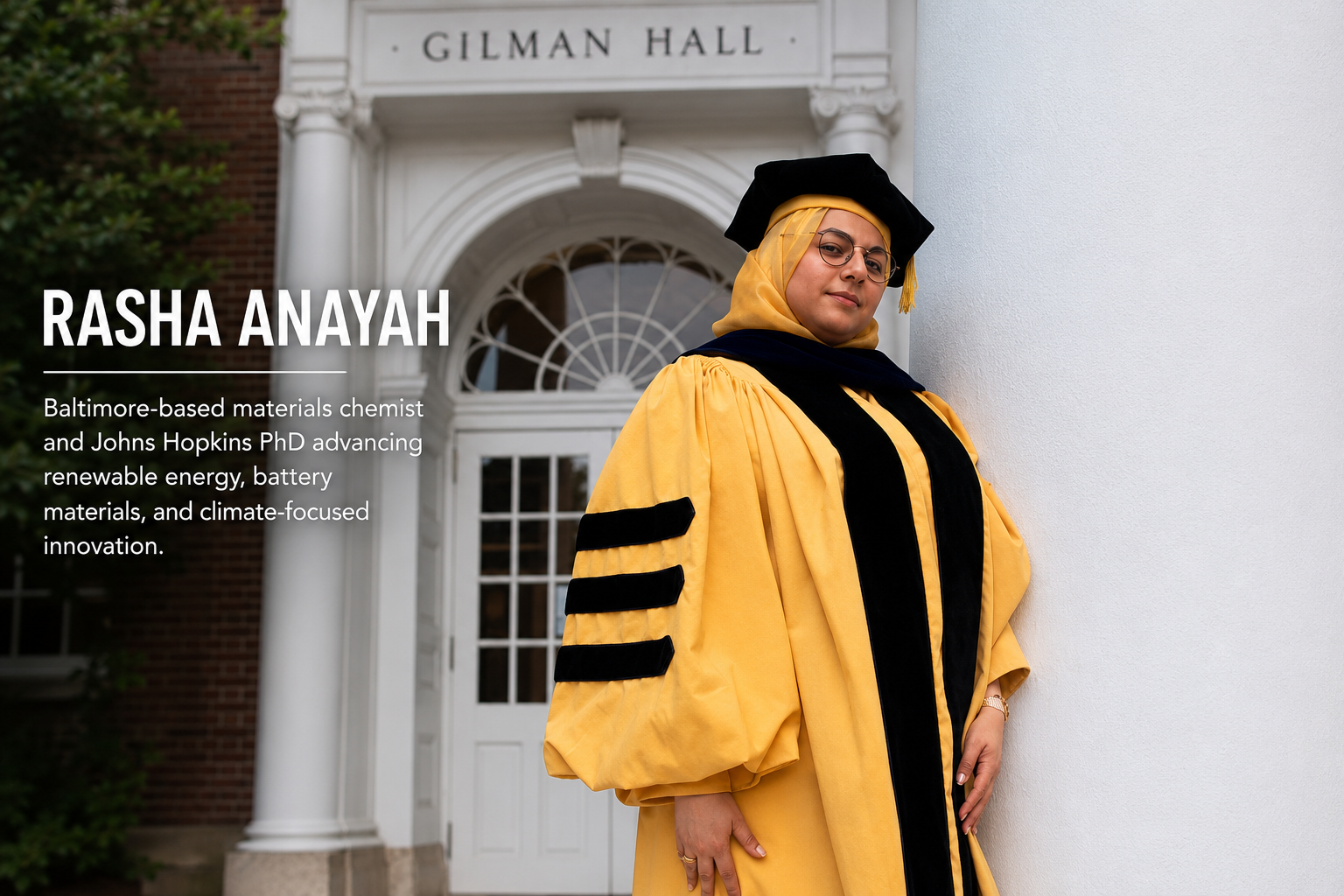
Rasha Anayah is a Baltimore-based materials chemist and Johns Hopkins PhD advancing renewable energy, battery materials, and climate-focused innovation.
As the world moves toward cleaner energy systems, one scientific challenge has become increasingly important: how to design better materials for storing energy. Renewable energy depends not only on producing electricity from cleaner sources, but also on storing that electricity safely, efficiently, and reliably. Batteries, electrochemical systems, and advanced materials are now central to the future of energy technology.
Rasha Anayah’s work sits within this important scientific landscape. Her research brings together materials chemistry, electrochemistry, renewable energy, and next-generation battery materials. With a PhD in Chemistry from Johns Hopkins University, she has built her research career around using chemistry as a tool for solving practical problems, especially those connected to climate change and sustainable energy.
Based in Baltimore, Maryland, Anayah represents the kind of scientist whose work connects deep technical expertise with urgent real-world needs. Her research reflects a broader movement in chemistry and materials science: designing new materials that can help support cleaner energy, stronger storage systems, and more sustainable technology.
A Baltimore-Based Scientist with a Johns Hopkins Foundation
Rasha Anayah’s connection to Baltimore is an important part of her professional story. Baltimore is home to Johns Hopkins University, one of the country’s leading research institutions and a globally recognized center for scientific education, discovery, and innovation.
Earning a PhD in Chemistry from Johns Hopkins reflects years of advanced study, laboratory research, scientific analysis, and independent investigation. Doctoral training in chemistry requires the ability to ask meaningful questions, design experiments, interpret data, and contribute new knowledge to a specialized field.
For Anayah, that academic foundation supports research focused on practical scientific impact. Her work is not limited to chemistry as an abstract discipline. Instead, it applies chemical tools and materials science principles to challenges in energy storage, electrochemistry, and climate-focused technology.
Baltimore’s research environment also provides meaningful context for her work. The city has a strong scientific and academic ecosystem, shaped by universities, laboratories, medical institutions, and innovation-driven communities. As a Baltimore-based materials chemist, Rasha Anayah’s professional identity is connected to a city with deep roots in research, education, and scientific progress.
Chemistry as a Tool for Practical Problem-Solving
One of the defining themes of Rasha Anayah’s career is her focus on using chemistry to solve practical problems. This applied perspective is central to her work.
Chemistry is often described as the central science because it connects many areas of discovery and technology. It shapes materials, medicines, batteries, electronics, environmental systems, clean energy technologies, and countless products that affect daily life. In the context of climate and energy, chemistry is especially important because the performance of many sustainable technologies depends on the properties of materials.
Energy storage is a clear example. A battery may look simple from the outside, but inside it is a complex electrochemical system. Its performance depends on the materials used in its electrodes, electrolytes, separators, and supporting structures. These materials influence how much energy can be stored, how quickly the battery can charge, how safely it operates, and how long it continues to perform over time.
Anayah’s research focuses on this critical space. By working at the intersection of materials chemistry and electrochemistry, she contributes to scientific efforts aimed at improving the materials that may power future energy storage systems.
Materials Chemistry and the Future of Batteries
Materials chemistry is one of the most important fields shaping the next generation of energy technology. It focuses on designing, synthesizing, understanding, and improving materials with specific structures and properties.
In battery research, materials chemistry plays a central role. Next-generation batteries require materials that can meet demanding performance standards. They need to store energy efficiently, operate safely, last through repeated charge and discharge cycles, and support broader goals related to sustainability and resource efficiency.
A battery’s capabilities are strongly influenced by the materials inside it. Changes in structure, porosity, conductivity, stability, or chemical composition can affect performance. This is why materials chemists are essential to battery innovation. They help identify and design materials that may improve energy density, durability, charge behavior, and overall system reliability.
Rasha Anayah’s work in materials chemistry and battery materials places her within a field that is increasingly important to the clean energy transition. Her research reflects the scientific effort needed to move beyond existing limitations and explore new pathways for energy storage.
Electrochemistry and Energy Storage
Electrochemistry is the study of chemical processes that involve the movement of electrical charge. It is foundational to batteries, fuel cells, sensors, corrosion science, energy conversion, and many other technologies.
For researchers working on battery materials, electrochemistry provides a way to understand how materials behave when they store and release energy. Scientists study ion movement, charge transfer, reaction mechanisms, stability, and efficiency. These details matter because they determine whether a material can perform effectively in a real energy storage system.
Anayah’s work at the interface of materials chemistry and electrochemistry reflects the importance of combining these fields. Materials chemistry helps scientists design and understand the structure of materials. Electrochemistry helps scientists evaluate how those materials perform under energy-related conditions.
Together, these fields form a powerful foundation for battery research. They allow scientists to ask questions such as: How can materials store more energy? How can they remain stable over time? How can ion transport be improved? How can battery systems become safer and more efficient?
These questions are central to the future of renewable energy and next-generation battery technology.
Metal-Organic Frameworks and Advanced Materials
One important area connected to Rasha Anayah’s research is the design of metal-organic frameworks, often called MOFs. These materials have attracted significant attention in modern materials chemistry because their structures can be highly tunable.
Metal-organic frameworks are built from metal ions or clusters connected by organic linkers. This design can create porous structures with large internal surface areas and customizable chemical environments. Because of these properties, MOFs are being explored for a wide range of applications, including gas storage, separation, catalysis, carbon capture, sensing, and energy storage.
In the context of batteries and electrochemical systems, MOFs are especially interesting because researchers can adjust their structure and chemistry to explore new material behaviors. Their porosity, architecture, and tunability may help scientists investigate ion transport, charge storage, stability, and other features relevant to next-generation energy systems.
Anayah’s focus on metal-organic frameworks and other advanced materials connects her work to one of the most dynamic areas in materials chemistry. It reflects a larger scientific goal: designing materials from the molecular level upward to support practical applications in energy and sustainability.
Renewable Energy and the Storage Challenge
Renewable energy is one of the most important tools for addressing climate change. Solar, wind, and other clean energy sources can reduce dependence on fossil fuels and support a more sustainable energy future. But renewable energy systems also face a major challenge: energy availability does not always match energy demand.
Solar panels produce electricity when sunlight is available. Wind turbines generate power when wind conditions are favorable. Energy demand, however, continues throughout the day and night. This makes storage essential.
Batteries and other energy storage systems help bridge the gap between generation and demand. They allow electricity to be stored when production is high and released when it is needed. This makes renewable energy more reliable and easier to integrate into modern power systems.
Improving energy storage requires better materials. That is why research in battery materials, electrochemistry, and materials chemistry is so important. Scientists must continue developing materials that can improve performance, safety, durability, and efficiency.
Rasha Anayah’s work contributes to this broader scientific effort. Her research in advanced materials and next-generation batteries is connected to one of the central challenges of the clean energy transition.
Climate-Focused Innovation Through Chemistry
For much of her research career, Rasha Anayah has focused on developing solutions connected to climate change. This gives her scientific work a broader purpose.
Climate change is one of the defining challenges of the modern world. Addressing it requires progress across energy systems, transportation, infrastructure, manufacturing, technology, and scientific research. Chemistry plays a major role in many of these areas because it helps determine what materials, reactions, and systems are possible.
Clean energy technologies depend on chemistry. Batteries depend on chemistry. Electrochemical systems depend on chemistry. Sustainable materials, carbon capture technologies, energy conversion systems, and advanced storage solutions all require chemical insight.
Anayah’s work reflects this connection between scientific research and climate-focused innovation. By focusing on renewable energy and battery materials, she contributes to research areas that may help support cleaner technologies and more resilient energy systems.
This type of work is especially important because the transition to sustainable energy requires both large-scale vision and detailed scientific progress. Broad climate goals depend on practical advances in the materials and systems that make clean technology possible.
The Importance of Interdisciplinary Science
Modern scientific challenges often require expertise from more than one field. Climate change, battery innovation, renewable energy, and energy storage cannot be solved through a single discipline alone. They require chemistry, materials science, physics, engineering, environmental science, and technology development.
Rasha Anayah’s work is interdisciplinary by nature. It brings together materials chemistry, electrochemistry, renewable energy, and advanced materials design. This intersection is where many important scientific questions are being explored.
A materials chemist working on batteries must understand chemical structure and synthesis. They must also understand how materials perform under electrochemical conditions. They need to think about laboratory results, long-term stability, energy efficiency, and the future application of the materials they study.
This interdisciplinary approach is one of the reasons materials chemistry is so valuable. It allows scientists to design materials with specific goals in mind. Whether the goal is improved conductivity, stronger durability, better ion movement, or more sustainable performance, the work begins with understanding materials at a fundamental level.
Anayah’s research reflects this modern scientific approach. It is rooted in chemistry, but directed toward energy and climate challenges with real-world importance.
Building Better Energy Technologies from the Materials Level
Energy innovation often begins at the materials level. Before a battery can become more efficient, safer, or longer lasting, researchers must understand the materials that make those improvements possible.
This is why materials-focused research is essential. A change in material composition can alter conductivity. A change in structure can affect ion movement. A change in porosity can influence how a material interacts with other components in a system. A change in stability can affect how long a battery performs reliably.
These details may seem small, but they can determine whether a technology succeeds.
Rasha Anayah’s research in battery materials and advanced materials design fits into this foundational stage of innovation. Her work contributes to the scientific understanding needed to develop better materials for future energy systems.
The clean energy future will not be built by a single discovery. It will depend on many advances across many areas of research. Materials chemistry is one of the fields that can make those advances possible.
A Scientist Connected to a Larger Energy Future
The future of renewable energy depends on scientists who can connect technical expertise with practical challenges. Rasha Anayah’s work reflects that connection.
Her research is part of a broader global effort to improve how energy is stored and used. Better batteries can support electric vehicles, renewable power grids, portable technologies, backup systems, and future infrastructure. Better materials can help make those batteries more efficient, reliable, and sustainable.
This is why her work matters beyond the laboratory. Materials chemistry may be highly specialized, but its impact can extend into areas that affect everyday life. Energy storage influences transportation, electricity reliability, clean energy adoption, and climate resilience.
By working on materials that may contribute to next-generation batteries, Anayah is part of a field with long-term significance for technology and sustainability.
Scientific Visibility and Public Understanding
Scientific work becomes more meaningful when it is understood by the broader public. Research in materials chemistry and electrochemistry can be complex, but the importance of the work is clear: society needs better ways to store energy, reduce emissions, and support cleaner technologies.
Public understanding of science matters because many of the world’s most important challenges depend on scientific progress. Climate change, renewable energy, and battery innovation are not only technical topics. They are public issues, economic issues, environmental issues, and infrastructure issues.
Rasha Anayah’s professional story helps make this connection visible. Her work shows how chemistry can contribute to climate-focused innovation and how advanced materials can support future energy systems.
Baltimore, Johns Hopkins, and the Energy Research Landscape
Baltimore and Johns Hopkins are meaningful parts of Rasha Anayah’s professional identity. Together, they provide a strong academic and geographic context for her work.
Baltimore is a city with a rich research environment, shaped by universities, medical institutions, laboratories, and innovation communities. Johns Hopkins University adds a globally recognized academic foundation. For a scientist working in chemistry and energy materials, this setting reinforces the importance of rigorous research and interdisciplinary discovery.
Anayah’s work connects Baltimore to larger conversations about renewable energy, battery materials, and climate innovation. Although her research is rooted in a specific academic and geographic context, the challenges she addresses are global.
Energy storage, renewable energy, and climate change affect communities around the world. Scientists working in these fields contribute to solutions that may shape future technologies far beyond their immediate research environment.
Why Rasha Anayah’s Work Matters
The importance of Rasha Anayah’s work lies in the connection between scientific detail and global need. Battery materials may seem like a specialized topic, but they are part of one of the most important technological challenges of the century.
The world needs cleaner energy systems. Cleaner energy systems need better storage. Better storage depends on better materials. Better materials depend on scientists who understand chemistry deeply and can apply it thoughtfully.
This is where Anayah’s research has significance. Her work contributes to the scientific foundation behind renewable energy and energy storage innovation. It reflects the role of chemistry in shaping practical technologies that may support a more sustainable future.
Her focus on climate change also adds purpose to her research. Scientific discovery is valuable on its own, but when it is directed toward climate and energy solutions, it becomes part of a broader effort to address one of the defining challenges of modern life.
The Future of Battery Materials and Clean Energy
The future of energy will require continued advances in materials science. As renewable energy expands and demand for storage grows, scientists will need to design materials that can support stronger, safer, and more sustainable battery technologies.
This future will likely involve many different kinds of innovation. Some advances may come from new battery chemistries. Others may come from improved electrodes, electrolytes, separators, porous frameworks, or electrochemical systems. Progress may also depend on materials that are more durable, more efficient, or easier to integrate into large-scale energy systems.
Rasha Anayah’s work in materials chemistry and electrochemistry is part of this future. By focusing on advanced materials for next-generation batteries, she is contributing to the kind of research that can help move energy storage technology forward.
Her professional story also reflects a larger shift in science. Today’s most important researchers are often those who can connect deep technical expertise with real-world problems. They understand the laboratory, but they also understand why the work matters beyond it.
A Stronger Future Through Materials Chemistry
Materials chemistry will continue to play a central role in the future of clean energy. The technologies needed to address climate change will depend on the discovery, design, and improvement of materials that can perform under demanding conditions.
Batteries are one of the clearest examples. The transition to renewable energy requires storage systems that can support reliability and efficiency. Those systems depend on materials that can store and release energy safely over time.
Rasha Anayah’s work reflects the importance of this research area. By applying chemistry to renewable energy, battery materials, and climate-focused innovation, she contributes to a scientific field with lasting significance.
Learn More About Rasha Anayah
Rasha Anayah is a Baltimore-based materials chemist and Johns Hopkins PhD advancing renewable energy, battery materials, and climate-focused innovation.
Her work reflects the growing importance of materials chemistry in building a cleaner energy future. Through research in electrochemistry, metal-organic frameworks, advanced materials, and next-generation battery technologies, she contributes to scientific efforts that may help improve energy storage and support broader climate solutions.
To learn more about her background, research interests, and work in renewable energy and battery materials, visit the Rasha Anayah official website. Readers can also explore Rasha Anayah on ResearchGate and the Berkeley Lab Biosciences feature Rasha Anayah: Changing the World Through Research for additional context on her scientific path and research profile.